After climbing a great hill, one only finds that there are many more hills to climb

It's easier to go down a hill than up it but the view is much better at the top.

Himachal Tourism

Saturday, 9 April 2016

Rain Fall Weather in Mandi Himachal Pardesh.

Rain Fall.
                 
Rainy Weather
Due to enough rainfall, idle earth is enclosed with forests or forms rich graze earth. In the hills the forest are wide and precious. Deodhar, blue pine, silver fir, spruce, chil and a variety of kind of oak are plentiful. Below 4,000 feet the forests are not extensive, the only valuable ones consisting of chil, but there is substantial rub jungle and the broad area of grass covered slopes support the herds of livestock. As may be predictable from the diverse height, the type of weather show large variations in the different parts of the district. It is attractive hot in the inferior portion in the summer and the cold is sour in the hills throughout the chill. And as such in each period, apart from the wet period, there is some place in the period where the type of weather is attractive.

Mountains of Mandi Himachal Pardesh.

Mountains .

Beautiful Mountains.
Approximately similar and organization downward the centre of the district is the Ghoghar-Ki-Dhar, of which the slopes are fairly gentle. It is not well forested, but contains big expanses of outstanding graze and the salty quarry of Drang and Guman. The Sikandar variety commence from the trijunction with Suket and Bilaspur and from there runs northward for fifty miles. The variety contain some high-quality forests of chil pine. but the better part of it consists of wealthy lawn slopes. It’s name is credited to Sikander Lodhi, who, 375 years previous to the time in power of Akbar, is hypothetical to have crossed it on his way to the take-over of Kangra. The variety of altitude in the region is high, with the uppermost tip life form approximately 13,000 foot on the Kullu edge and the lowly point 1,800 feet near Sandhol where the Beas leaves the district. The only area which is similar to the plains is the Balh valley. Several of the valleys are unlock and are frequently irrigable from kuhls, or small water channels, and hold some of the most lush ground in the state. Due to the mountainous land, some of the hills are so steep that farming in big scale is not possible.


Main River in Mandi Himachal Pardesh.

Main River in Mandi.

Exotic view of Lake between Mountains
Inside the area the main tributaries of the Beas on the north bank are Uhl, Luni, Rana and Binu and on the south bank are the Hanse, Tirthan, Bakhli, Jiuni, Suketi, Ranodi, Son and Bakar. The better fraction of the area is mountanous land with the main ranges of maountains organization from the north to the south with the scheme being out of order up by countless slanting spurs. The mainly obvious is the Jalori variety which is crossed by a far above the ground road from from Kullu to Shimla by a go by named as Jalori pass. It divides the watersheds of the Satluj and the Beas and on it’s northern slopes is unusually well forested with deodar and blue pine forests of huge worth. the uppermost climax in the variety is Shikari Devi (11,060 feet), it’s peak life form crowned by a shrine to a restricted goddess. The variety throws off three main spurs which make bigger all through the area recognized as the Mandi Saraj. To the north of the Beas is the Nargu variety, a continuance of the Bir Bhangal, seperating Mandi from Kullu good and cross by the Bhubu pass (9,480 feet). The mountains here run upto 13000 feet, the slopes frequently life form very steep and the valleys bottomless.


Geography Of Mandi Himachal Pardesh.


Geography Of Mandi.

The region is located flanked by 31-13-50 and 32-04-30 north leeway and 76-37-20 and 77-23-15 east longitude. It is surrounded by Kangra on the north-west, Hamirpur & Bilaspur in the west, Arki tehsil of Solan district in the south, Shimla district in the south-west and Kullu district in the east. The region has 2 main rivers viz. the Beas and the Satluj. The river Beas enters the district from close to Bajaura, at the border of Kullu and foliage the district at Sandhol. The Mandi city is also situated on the banks of this river. For the better fraction of it’s distance end to end, it runs flanked by high banks and as it is of by no means huge width, the present is speedy, particularly throughout the rains. almost the entire of the region drains into the Beas with only the south-east bend located on the Satluj watershed.


Mandi is the second most populous town in Himachal Pradesh after Shimla.

 History  of Mandi.

This historic city has maintained with much of its past glory and modishness
Not a great deal is recognized concerning the near the beginning the past previous to the configuration of Suket in 765 AD. The district had been beneath the control of Ranas or Thakurs. The merely place that has an near the beginning talk about in text is Rewalsar and it is mentioned in the Skanda Purana as a holy place of pilgrimage. Karnpur, a little rural community is supposed to have been founded by Karan, a brave man of the Mahabharta. A temple at Gumma points to the area anywhere the Pandavas protected themselves when the effort to be on fire them downfailed. further than this not a great deal of the previous state’s survival can be establish in traditional text. According to the Tibetan custom, Padam Sambhav (750-800 AD), the huge Buddhist Patriarch, who was summoned by king Tisong-De-Tsen of Tibet for preaching Buddhism, hailed from Zahor, which represent the country surrounding concerning Rewalsar. On the foundation of this it is finished that Mandi must have been a huge place of Buddhist knowledge concerning this occasion.

mandi in himachal .
 The current region Of Mandi was shaped with the amalgamation of two generous states Mandi and Suket on 15th April 1948, when the State of Himachal Pradesh came into survival. Ever since the configuration of the region, it has not witnessd any changes in it’s authority. The chiefs of Mandi and Suket are supposed to be from a ordinary forebear of the Chandravanshi line of Rajputs of Sena family of Bengal and they maintain their fall from the Pandavas of the Mahabharata. The intimates of the line supposed to have ruled for 1,700 years in Indarprastha(Delhi), awaiting one Khemraj was ambitious out by his Wazir, Bisarp, who then took over the throne. Khemraj, having lost his knogdom, fled eastward and established in Bengal, where 13 of his successor are supposed to have lined for 350 years. From there they had to run away to Ropar in Punjab, but here also the king, Rup Sen, was killed and one of his sons, Bir Sen, fled to the hills and reached Suket. The State of Suket is said to have been founded by Bir Sen, an forebear of the Sena family of Bengal.

Beautiful city mandi.
The seperation of Mandi from suket took place concerning the year 1200 AD. Upto that time, it was the single state of Suket. The then reigning chief Sahu Sen had a argue with his younger brother Bahu Sen, who absent Suket to look for his fortunes somewhere else. Bahu Sen following send-off Suket established at Manglan in Kullu, anywhere his descendents live for 11 generations. Then then leader, Kranchan Sen was killed combating against the Kullu Raja and his Rani, who was pregnant at that time. fled unaccompanied to her father who was the leader of Seokot, who had no son. Here she gave delivery to a baby boy who was named Ban, the tree beneath which he was born. Ban had barely crossed the age of 15 when he beaten the leader of Kilti who second-hand to steal travellers.On the bereavement of the leader of Seokot, Ban succeeded to the chiefship of Seokot. He, after some time killed the Rana of Sakor and took posesssion of his lands. he then changed his house to Bhiu, on the bank of Beas and a few miles from the there Mandi city. Mandi emerged as a seperate condition in the begining of the sixteenth century. downward the row of offspring of Ban came Ajbar Sen, nineteenth in fall from Bahu Sen, who founded Mandi city in 1527 AD, the capital of the previous condition of Mandi and the head office of the at the present Mandi District.


Mandi city.
Ajbar Sen was the primary huge leader of Mandi. He was almost certainly the primary to take for granted the title of Raja. He consolidate the territory that he had present at birth and additional to them new ones that he wrested from the hands of his neighbours. He built a fort here and decorated it with four towers. He also built the temple of Bhut Nath and his Rani constructed that of Trilok Nath. downward the row of offspring was Raja Sidh Sen, who succeeded Raja Gur Sen in 1978 AD. Mandi had by no means been so influential previous to his time in power and following that by no means was. He captured huge areas from the next-door areas. it was through his time in power that Guru Govind Singh, the tenth guru of the sikhs visited Mandi in the close of the 17th century. He had been locked up by Raja singh, the leader of Kullu, from whom he had required help next to Mughal troops and his group consider that Guruji runaway by by amazing powers. Raja Sidh Sen, who is also careful to be a posessor of huge amazing powers, entertained his with huge welcome. He built the huge tank previous to the fort.


Mandi Pics .

He also built the temples of "Sidh Ganesha" and "Trilokinath". The whole the past of together the states of Mandi and Suket is beleaguered with wars with in the middle of themselves and other next-door states. These two states had forever been rivals and usually enemy, but there was no huge consequence of their fighting. The lush vale of Balh was the ordinary earth of wish and argument. On 21st February 1846 the chiefs of Mandi and Suket visited Mr. Erskine, Suprintendent of the Hill States for the British Government, due their loyalty to the Britishers and securing their defense. on 9th march, 1846 a agreement was finished flanked by the British Government and the Sikh Durbar whereby the entire of the Doab area flanked by the Beas and the Sutlej was ceeded to the British Government, and this built-in the ststes of Mandi and Suket also. On 1st November 1921, both the state of Mandi and Suket were transfer from the following manage of Punjab Government to that of Government of India till 15th August 1947, India’s Independence Day.


Thursday, 7 April 2016

Place to visit in Hamirpur Himachal Pardesh.

Sujanpur Tira.

sujanpur tira picnic spot.
 It was found by Raja Abhay Chand, the king of decision Katoch family of Kangra in 1748 A.D. There is a crypt of Nawab Gulam Mohammed of Rampur. There are five old temples at Tira and Sujanpur. Bara-dari (Court Room) of Raja Sansar Chand at Sujanpur.The temple devoted to Gauri Shankar was build throughout the occasion of Raja Sansar Chand in 1793 A.D. in the holy reminiscence of his mother. The place of worship of Murli Manohar and Narbadeshwar (built by Pransani Devi, The Suketi rani of Raja Sansar Chand) were also builit in this time in 1970 and 1823 A.D. in that order. additional temples of standing are the Mahadev temple, Devi and Vyasheshwar devoted to Rishi Vyas) temple. Obreen’s horses serious ( he was Raja Sansar Chand’s commander) is also located in Sujanpur. This country was first visit by a German, named ‘Traveck’ and then by a British traveller named ‘Moorcraft’. Sujanpur place is appropriate for escapade sports like Paragliding, Angling, Rafting and trekking in and approximately this region.

Nadaun. 

Nadaun in Himachal.
 In generous days, it is second-hand to be the head office of the Nadaun Jagir, Maharaja Sansar Chand of Kangra second-hand to grasp his courtyard throughout summer for a figure of year throughout his time in power. Nadaun is also Known for Bilkleshwar Mahadev temple which is supposed to be contain been founded by the Pandavs. Nadaun FortNadaun is well-known for its good-looking citizens and a Gurudwara found in A.D. 1929. Nadaun was a gay place, throughout the time in power of Sansar Chand II. There was a proverb present in Kangra hill (Who that comes to Nadaun will not go away). This is explain by the information that there were two hundred live and dancing girls at Nadaun and whoever come under the magic charm of these enchantresses by no means consideration of leaving. therefore writes Ghulam Mohiuddin in Tarikh-i Punjab. It is peaceful town with a good Rest House, an Old Palace and Shiva temple. The fortress structure at Amtar still house some of the painting of that time. Jawalajee temple is also not very far and can be visited from here. This place provides outstanding amenities for Mahaseer fish in the Beas River graceful close by. one more magnetism is the river rafting from this place to Dehra and further. There are good-looking camp site for anglers.

Deotsidh Temple.


baba balak nath temple . It is located on the edge of Bilaspur (70 Kms), Hamirpur (30 Kms) and is fit linked by roads from all sides.  icon of Shri Baba Balak Nath ji, Deotsidh Hamirpur (H.P.)throughout Navratras, there is a incessant watercourse of guests to take delivery of blessings of the Babaji. Government makes arrangements for stay in tented colonies and provides water, toilets and other essential services. extra somewhere to live and fitting of cord way to Shah - Talai is predictable to catch the attention of more tourists. This temple is one of the main income earning institutions of the Himachal state and is visited by nearly 45 lakhs of devotees crossways the country each year. ‘Mela’s are prearranged throughout Holi fair. Sunday is careful favorable day of Babaji and as a result attracts huge devotees on this day.

Markanda.
markanda river.
 It is situated in district Hamirpur, 6 KM away from Dera parol on the bank of Kunah Khad is the place of Markandya Rishi. According to Puranas, it is present that the icon of Rishi Markandya was installed. A usual water coil is also situated there. The fair of markanda is also well-known.


Bhota.

Hospital at Bhota, Hamirpur It is situated on Dharamshala-Shimla road at a distance of 15 KMs. from Hamirpur towards Bilaspur. The place is well-known for Radha Swami Satsang and one of the biggest charitable hospital of the state have been constructed by the same spiritual trust.


Narvdeshwar Temple. 

Narvdeshwar temple.
Narvdeshwar Temple is located in the Sujanpur town. It was got built by the leader queen of Maharaja Narvdeshwar Temple at SujanpurSansar Chand. Artists belonging to the court of Raja has haggard bright and gorgeous movies pertaining to Ramayana, Mahabharta & Bhagwat Puran and also of untamed animals and birds.  The temple has been constructed in the open ground. There are little temples constructed approximately the main temple of Sun, Durga, Ganesh, Laxmi Naryana and Mahisasur Mardini. The temple is in excess of two hundred years old built in Bhitti method.

Bil-kaleshwar Temple.


Temple Of God Shiva.
 This temple of God Shiva is located at a distance of 5 km on the Nadaun- Sujanpur road at the gathering place of Beas river and Kunah Khad. This temple is concerning more than 400 years old. In the month of ‘Baishakh’ ( May-June), throughout the mela big figure of devotees visit this place to have a sight of Shivling. According to the very old grape-vine, the building of this temple was in progress by the ‘Pandavas’ of ‘Mahabharatha’ celebrity with the help of Vishva-Karma in the night during their clandestine banish. But the building of the temple was dump by ‘Pandavas’ as they were dotted by the restricted citizens. afterward on, this temple was constructed by the King of Katoch family. This pilgrimage place is careful as holy as Haridwar in Uttaranchal. The people who are not capable to visit Haridwar, submerge the earthly leftovers of their relations, in the holy water of this place.

Murli Manohar Mandir.


Lord krishna &Radha Temple.
It is located in the past chowgan of Sujanpur Tira. Murali Manohar Temple at Sujanpur.This place of worship is extremely aged and is constructed in "Shikar Style". imagery of Lord Krishna and Radha are located in it. The timber work is enclosed with statue of sole scenes. There is an open patio near the temple where imagery of dissimilar Gods and Goddesses are located. This temple was constructed throughout the time in power of Maharaj Sansar Chand.                                                                                                                          
Tauni-Devi Temple.

Tauni Devi Mandir.The temple of goddess Tauni- Devi is located on the Hamirpur- Awah devi road at a distance of  about 12 km from Hamirpur. The temple is additional than 200 years old and a pale is detained throughout the month of Asharh (June- July). A big figure of people visit this temple throughout the fair. This goddess is careful as the sister of goddess Durga. People visit this place to get free of raining period deceases. The temple is well managed by a local committee.


Baba Balak Nath.  

Sidh Baba Balak Nath Temple.This temple is located in village Chakmoh of region Hamirpur. It is 45 Kilometers from Hamirpur and is on the edge of Hamirpur and Bilaspur districts. It is one of well-known temples of the Northern India. A sight of Baba Balak Nath Temple at DeotSidhIt is located on the pinnacle of a superb hill. There is a cavern imprinted out of a astound which is affirmed to be the house of Babaji. An icon of Babaji is placed in this cave. The devotees offer ‘Rot’ prepared with floor and Sugar / Gur at the altar of Babaji. a number of of the devotees offer goats. admission of females in the cavern is prohibited. There is a raised stage just conflicting to the cavern from where the females can have ‘Darshan’ of Babaji. Six kilometers from this place of worship, there is a place called Shah-talai anywhere Baba is said to have skillful reparation. There is a faith that is ‘Sidh Baba Balak Nath Temple Trust’ that keeps a timepiece on the performance of the temple. ‘Mela’s are prearranged throughout Holi fair. Sunday is careful favorable day of Babaji and as a result attracts huge devotees on this day.

Awah-Devi Temple.


Awah Devi.
 The temple Jalpa Devi (Awah Devi) is located in tehsil Bhoranj on Hamirpur- Sarkaghat road at a distance of 24 km from Hamirpur. Mandir is located in the good-looking nearby on the pinnacle of a hill. This place serves as a well known connection since roads pending from Bilaspur, Mandi, Kangra and Una pass from side to side this place. This temple is over 250 years aged and is managed by a local group. As per the restricted story, the citizens of Mandi region required to take the icon of goddess to their place. As they were transport the icon to their place, they misplaced their eyesight. When they twisted back, their eyesight was re-stored. At the last they were compulsory to place the icon at that place from anywhere they were in use it. Since then, the restricted citizens have de-confidence in the goddess. the majority of the people adoration this goddess as their family goddess (Kul-devi). Every year big number of devotees visit this temple and implore for satisfying their needs.  environmental review of India, has selected this place ( hill of                                                                         temple ) as utmost height for the District Hamirpur.

Gasota Mahadev Temple.


Shiv Mahadev Temple.
  Shiv Mahadev temple Gasota is over 400 Shiv Mahadev temple at Gasota 20 years ago.hundred years old and is located on Hamirpur- Jahoo road at a distance of  8 km from Hamirpur.  A pale is held on 1st Monday of ‘Jeshtha’  month (last May) every year. This fair is also recognized by the person's name of cattle fair Gasota. People and traders visit this place throughout mela to have sight of Shiv- linga and for advertising and trade of livestock. This is very good-looking place. usual water streams run on both sides of the temples which adds to its loveliness. A cow hut and inn has been built in the temple multifaceted to make easy visitors. The                                                                                               temple is managed by the local panchayat.

Jhanyari Devi Temple.
Durga devi mandir.
Jhanyari devi (Durga) temple is located on the Hamirpur- Nadaun road at a distance of 6 km from Hamirpur. This temple is extra than 200 years old and is managed by a local group. Every year on the eve of ‘Jeshth- Shukla’ ‘ashtami’ a pale is detained here. Jhanyari devi templeDuring this period local citizens and people from off places visit this temple. It is past temple since it is supposed that king of Katoch family used to adoration this Goddess as kul- devi (ancestral goddess). According to the aged saying, the Goddess heading for king belonging to Katoch Dynasty in the dream to establish here a temple within his temple complex. The king go to transport the icon of goddess accompany by a enormous procession with a palanquin (palki). When the procession reached the purpose and located the palanquin on the soil to get the idol of Goddess. But when they in progress exciting palanquin, they might not do so as its heaviness greater than before extremely. As a result  of that the procession along with the king had to stay there. During the night in the dream the goddess told the king that once palanquin is lifted to fetch the goddess, it be supposed to not be located on land. therefore the icon be supposed to be recognized at the same place where the there temple is situated.

Kalanjari Devi.


Kalanjari Mata Mandir.
 The temple of mother Kalanjari devi is located on the Hamirpur- Awah devi road at a distance of about 6 km from district Hamirpur. This temple is additional than 200 years old. big number citizens and saints visit this temple to seek the blessings of this goddess. each year throughout the month of ‘Asharh’ (June- July) a huge fair is detained here. A large figure of people visit this temple in the expect of that their needs will be fullfilled by the goddess.


Gurudwara sahib Nadaun.
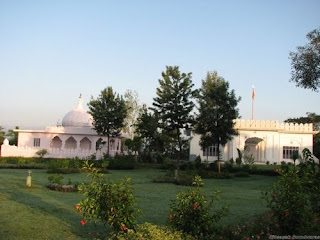
Gurudwara sahib Nadaun.

 Shri Gurudwara Saheb10th Patshahi is located at Nadaun in District Hamirpur at a very good-looking put at the bank of Beas river. This Gurudwara is managed by the Shiromani Gurudwara organization group Amritsar, Punjab. There exists good agreement for the at ease wait for the guests at this place. It is a past Gurudawara. According to the past Shri Guru Gobind Singh has fight second fight of his existence which he has described in 10th Granth ‘Nadaun Jang’. The fight was fought on 4th April 1891. The first fight was fought flanked by Shri Guru Gobind  Singh and king of Bilaspur near Bhagani Pavnta Saheb. Second fight was fought by Shri Guru Gobind Singh ji  with Mughals on the invite of head of hilly king Shri Bhim Singh king of Bilaspur. Guru Gobind Singh came to fight the fight along with a collection of 500 Sikhs with Mughals lead by Alfa Khan Hussain. Mughals were beaten in this fight. Shri Guru Gobind Singh stayed at this place for eight days following the fight.


Peer- Saheb Grave. 


Peer saheb grave.
 Peer Saheb Grave is located at a distance of 1 and ½ km absent from Nadaun sub-separation on the way of Nadaun- Hoshiarpur road at village ‘Bharmoti’, tehsil Nadaun district Hamirpur. This serious is 30 km away from Hamirpur. According to the local the past, Sai Fazal Shah was very well-liked saint for this region. citizens have  their blind confidence winning him as he left his figure of  strange things throughout his life, by which he became very well-liked in the middle of citizens. A large ‘Bhandara’  is prearranged in the last month of ‘Magh’ (2nd  week of February). A wrestling rivalry is also prearranged here. King of Katoch family Sansar Chand was also very much frightened by his secrecy. Sansar Chand king of Katoch family had constructed a serious here.


Hamirpur is a culturally charming city in Himachal Pradesh

Physical.


Map Of Hamirpur.
The Hamirpur locality is located between  76-17-50  to  76-43-42 east longitudes  and  31-24-48  to  31-53-35  north latitude.  It is situated in the south western fraction of Himachal Pradesh.  It is enclosed by lower Himalayas, the height varies from the 400 meters to 1,100 meters.  The main hill ranges of the region are recognized as Jakh  Dhar &   Sola Singhi Dhar. The  Jakh dhar runs in continuance of Kali Dhar range in the Kangra region.  It enters in  Hamirpur  region  near  Nadaun  and transverses it  into southeastern way.  The city of Hamirpur dishonesty to the east of this variety where the country is rolling but in  the north  and  north  east  bare  and  rocky  hills,  bottomless ravines with    steep  sides  change  the  scenery  into  what  has   been describe as an nervous sea abruptly under arrest and set pebbles. The Chabutra  hills  have the similar dip and hit as in the Jakh Dhar and are sustained further than the Beas to what is recognized as the Changar, a accumulation of rocky and broken hills.  The Sola  Singhi  Dhar  is  the  best  variety  of  the  area  and  is  recognized  beneath  a variety of  names  such as Chintpurni and Jaswan Dhar in Una and by  Sola  Singhi  in  Hamirpur. Thus  Dhar  enters Hamirpur to the east of Tappa Daruhi and traverses it in a south-easterly way more or fewer similar  to  the  Jakh  Dhar and ended on the Satluj. Hamirpur locality is surrounded in the north by river Beas which separate it  from Kangra region.  In the east Bakar and Seer Khads divide it from Mandi region.  In the  south, It  is  surrounded  by Bilaspur region and in the west by Una district. 

History.


beautiful place hamirpur. The history of Hamirpur is intimately connected with the Katoch family which ruled the area flanked by the Ravi and Satluj rivers in the past days. It is obvious from the “Puranas” and Panini’s “Ashtadhyai” that through the Mahabharta period, Hamirpur was a fraction of the old Jallandhar-Trigarta empire. Panini referred to the citizens of this kingdom as huge warriors and fighters. The custom of those citizens seems to have sustained till today, as is obvious from the large figure of people from the district in Indian defence armed forces. It is supposed that in the very old age, the rulers of Gupta dynasty had set up their dominion in excess of this fraction of  the earth. throughout the center ages, most probably the area fell beneath the manage of Mohammed Gazani, Timurlang and later Sultans. But with the way of time, all the aforementioned rulers went absent and at the time of Hamir Chand, a Katoch ruler, the area was beneath the control of  ‘Ranas’ (Feudal hill chiefs). Some of the famous Ranas were, ranas of Mewa, ranas of Mehalta and Dhatwal. There was no time when these feudal chiefs were not in argue next to each other.  It was only  the Katoch dynasty which put these Ranas beneath its manage, to make sure an arranged civilization. The Katoch dynasty became main throughout the age of Hamir Chand who ruled from 1700 A.D. to 1740 A        It was this ruler who built the fortification at Hamirpur and the there city of Hamirpur  derives its name from this ruler. Hamirpur came to a great deal emerald–light only throughout the age of Raja Sansar Chand-II. He made ‘Sujanpur Tira’ his capital and erected palaces and temples at this place. Raja Sansar Chand  ruled from 1775 A.D. to 1823 A.D. He dreamt of establishing the old territory of Jallandhar-Trigarta, which his intimates had held at one time, Perhaps according to some historians he tried two times ineffectively. The go up of Raja Ranjit Singh proved a great obstacle for his ambition. so, he unfocused his notice towards the local hill chiefs. He emotionally involved Mandi state and made Raja Ishwari Sen a pioner for 12 years at Nadaun.

hamirpur in himachal
He also grateful the Suket ruler to pay an yearly tribute and annexed parts of Bilaspur state on the right bank of Satluj. flattering worried by the progression of Sansar Chand, all the hills chiefs connected hands and invite the Gurkhas to stop the unrestrained strength of Katoch ruler. The joint army fight next to Sansar Chand’s  army at Mahal Morion in Hamirpur. Raja Sansar Chand army gave a devastating beat to the joint forces and bound them to move away on the left banks of river Satluj. By that time, Raja Sansar Chand, on the recommendation of his General Ghulam Mohammed tried to effect the financial system in the army by replacing the obtainable ones with Rohillas. This prove a self defeat foolishness on his fraction. On trial about the flaw of Katoch’s army, the joint forces again attack the forces of Kangra at Mahal Morian in the second fight and compulsory a devastating defeat in 1806 A.D. Raja Sansar Chand along with family took protection in the Kangra fort. The Gurkhas sieged the Kangra fort and cruelly looted the area flanked by the fort of Kangra and Mahal Mohrian and nearly shattered the villages. Ishwari Sen was unconventional by the Gurkhas from Nadaun jail. The blockade of the fort sustained for three years. Raja Ranjit Singh on the ask for of Sansar Chand, wage war next to the Gurkhas and beaten them in 1809 A.D. But  Sansar Chand  had to pay a serious price whereby he had to misplace Kangra fort and 66 villages to the Sikhs. The Sikhs maintain their dominion over Kangra  and Hamirpur till 1846 when they were beaten by the British army in the first Anglo-Sikh war. Ever since, the preeminence of the British sustained in the area which became a part of the British empire. Sansar Chand died as a most disenchanted man. His heir ( grandson) Raja Pramodh Chand in coalition with the Sikhs and other rulers tried unsuccessfully to remove the British.

natural beauty of hamirpur.
            
The British made Kangra, of which Hamirpur shaped a part, a region in which Kullu and Lahaul-Sipiti were also compound to form the part of the district. In 1846, after capture of Kangra, Nadaun was made the tehsil headquarters.   This resolution was revise in 1868, and as a consequence the tehsil headquarters was distorted from Nadaun to Hamirpur. In 1888, Palampur tehsil was shaped, merging part of the areas of Hamirpur and Kangra tehsils.    Hamirpur remained a part of Punjab region awaiting 1st November 1966, when these area were compound in Himachal Pardesh resulting ahead the reform of the Punjab. As a consequence of re-agreement of the districts in the compound areas on 1st September 1972, Hamirpur was created as a separate district with two tehsils of Hamirpur and Barsar. In 1980  three more tehsils viz. Tira Sujanpur, Nadaun, Bhoranj were shaped with the additional restructuring of the tehsils. Of these Nadaun and Bhoranj have  become  full tehsils at  the  1991  census.   Presently, district has five tehsils viz,  Hamirpur,  Barsar,  Bhoranj,  Nadaun  and  Sujanpur   and   one sub-tehsil i.e.   Dhatwal  at  Bijhari.  It consists of three Revenue Sub-Divisions namely, Hamirpur, Barsar  and  Nadaun.    The  Hamirpur associate-separation comprise of Tehsils Hamirpur, Bhoranj and Sujanpur, the Barsar associate-separation comprise Barsar Tehsil and Sub-Tehsil Dhatwal at Bijhari,  whereas  Nadaun  Sub-Division  comprises  only  one  Tehsil Nadaun.  This District has been divided into six  Development  Blocks such  as  Hamirpur,  Bijhari,  Bhoranj,  Nadaun,  Sujanpur  and recently shaped Bamsan at Touni Devi.